Businesses launching their own app
Companies that want to move ordering, booking, loyalty or campaigns onto their customers’ phones.

We build mobile apps, web platforms and SaaS products where several parties, such as customers, businesses and couriers, work together. One team takes them from design to launch and ongoing maintenance.
Companies that want to move ordering, booking, loyalty or campaigns onto their customers’ phones.
Marketplaces, SaaS and service platforms that bring together users, businesses and couriers.
Teams that want to move work run on spreadsheets and email into one web panel with roles and reports.
Screen flows, interface design and a clickable prototype you can try before any code is written.
One codebase for both platforms, with separate apps for customers, businesses and couriers when needed.
Subscription software products, customer portals and fast corporate websites.
The panel where you manage users, orders and reports, and the backend that powers the apps.
Building blocks we have used in our own products.
We handle the app store review process, then ship version updates and new features after launch.
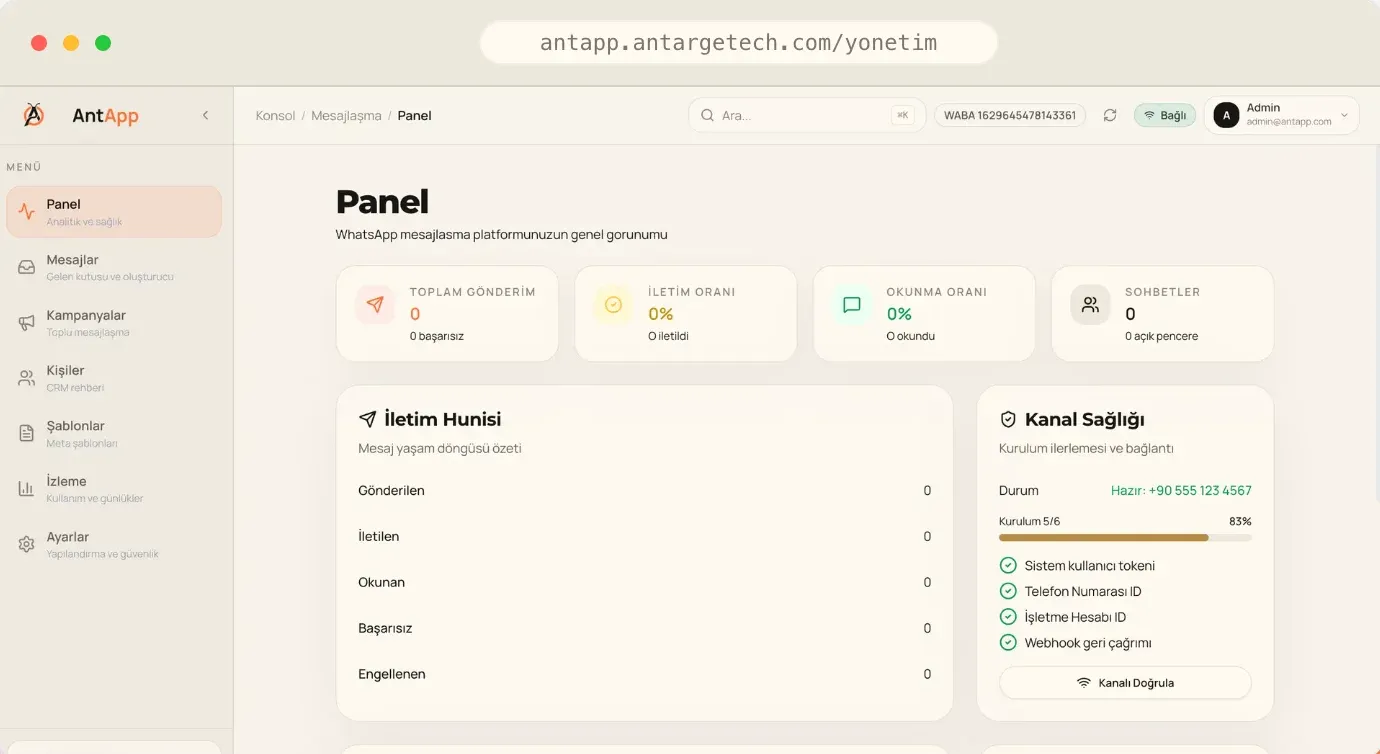
We build and ship our own products too: ÇAK’s customer and business apps were built with React Native and published on the iOS, Android and Huawei stores, ANTLY’s courier and business apps track deliveries in real time, and AntApp is a WhatsApp Business console we built with Next.js. You work with a team that thinks like a product owner.
We listen to your needs, goals and constraints in a free first meeting.
We put the scope in writing and prepare an itemised quote.
We work in short stages and share a working version with you at the end of each one.
We launch, then stay with you for maintenance, monitoring and new features.
Four ways to send bulk messages on WhatsApp: broadcast lists, business broadcasts, unofficial tools and the Business API, with limits, costs and risks.
Read More: WhatsApp bulk messaging software: how to send without getting your number bannedWhat LCP, INP and CLS measure, their thresholds, the difference between field and lab data, and concrete ways to improve each metric.
Read More: How to improve Core Web Vitals: a practical guide to LCP, INP and CLSThe user roles, screens, platforms, integrations, app store fees and maintenance that determine what a mobile app costs to build and run, explained one by one.
Read More: What determines the cost of developing a mobile app?We start with a free first meeting to hear your idea, your users and your goals. We then write up the scope and send an itemised quote. Once approved, we begin with screen flows and a clickable prototype, build in short phases and share a working version at the end of each phase. Finally we publish the app on the App Store, Google Play and, if needed, Huawei AppGallery, and continue with maintenance.
Usually we build both platforms from one codebase (React Native), which shortens delivery and lowers maintenance costs. We add platform-specific modules when needed.
Yes. The web panel where you manage users, content, orders and reports is part of the project.
Yes. We recommend launching with the most critical features first (MVP) and adding new ones based on real user data.
The main factors are the number of user roles (customer, business, courier…), the number of screens, integrations and the scope of the admin panel. We don’t sell fixed packages; after the first meeting we send a written, itemised quote.